|
|
|
|
|
|
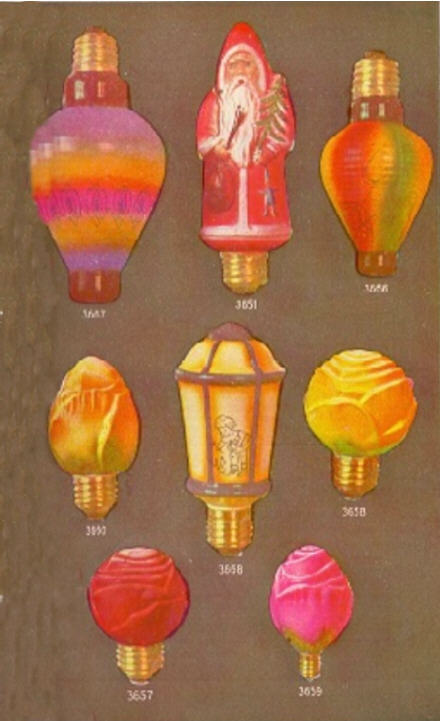
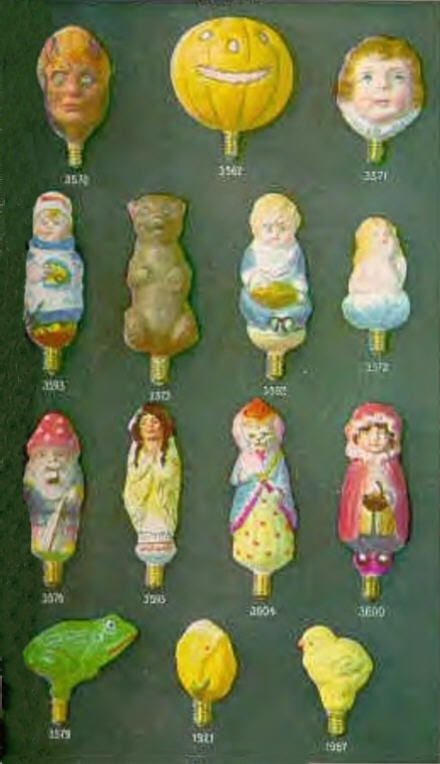
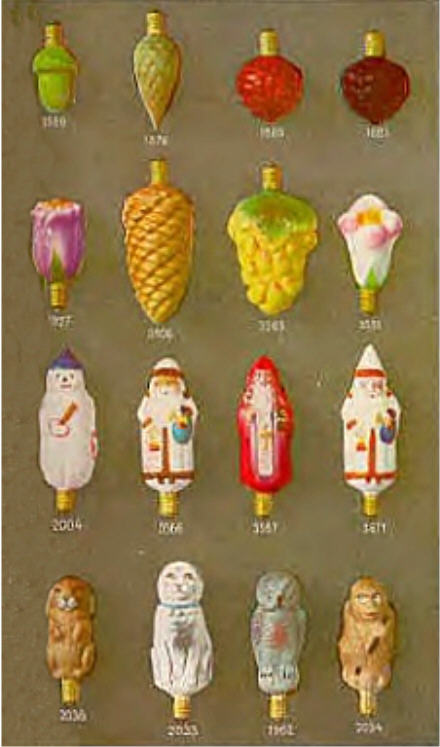
| Here are some
pages out of a late 1920s German
"Fancy Lamp" catalog, containing many general purpose and highly
decorative lamps. Also
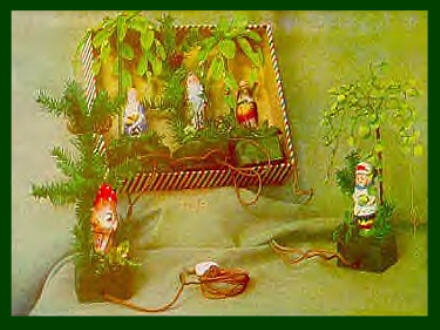
note the two pictures of suggested uses for these miniature lights- in
scenes
built into a box lid and also in small hanging baskets of lighted
fruit. Most of
the particular lights shown here are quite hard to find today, and are
highly
collectible. They are wonderful examples of the fine German
craftsmanship of the
era. The Jack O' Lantern is particularly rare, as are some of the
standing
figures. All examples are hand painted clear glass. Except for the rose
in the
lower right hand corner of the first picture, the rest of the lamps in
that
group are standard base (regular household) size bulbs. Uses for these
larger
lamps included hallway, front door and wall fixtures.
Also see the next page of this section for another catalog of early figural lamps. |
||||
 |
 |
 |
 |
 |
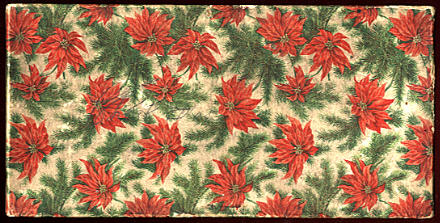
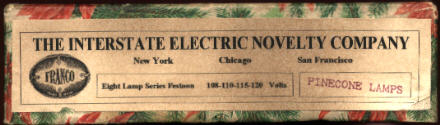
| THE INTERSTATE ELECTRIC NOVELTY COMPANY imported these lights circa 1915. This company, one of the 15 that later merged to become NOMA, was one of the "biggies" in the early history of electric Christmas lighting. Formed in 1912 by the merger of the Franco-American Electric Company and Alfred Wolfe and Company, they made and distributed many forms of decorative lighting, including regular and figural Christmas lamps. In 1920, the Company changed their name to The Franco Electric Company and sold the Yere-Round line of decorative lights. In 1923 their name was changed to Yale Electric, then in 1925 to Premo Electric. By 1926, the company was a part of NOMA. The lights in this set are carbon filament German outside painted clear glass, with composition fiber insulators. | ||
 |
 |
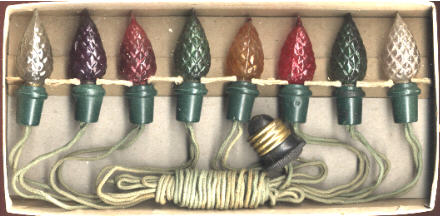 |
| Outside of box | End label of box | Inside view |
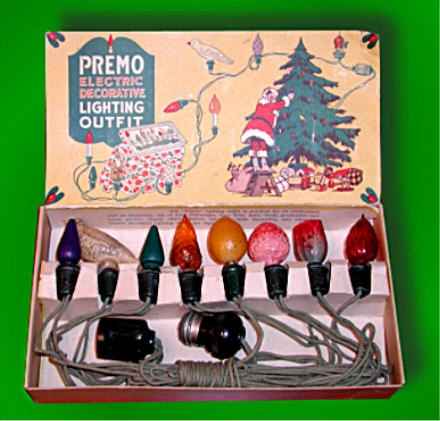
| Here's a set of figural lights by Premo, one of the companies discussed in the box immediately above. The Premo name was used for Christmas lights for only one year, so it is easy to date this extremely hard to find outfit to 1925. Many of the figural lights in the set are original, as they match the box art perfectly, as does the string. My search continues to find all of the proper figural lights to complete this set. I've seen only one other example of this outfit, and it was missing the lid to the box. This was quite an exciting find for me! | 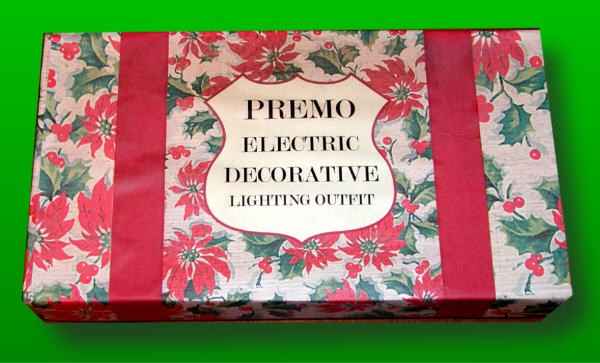 |
 |
|
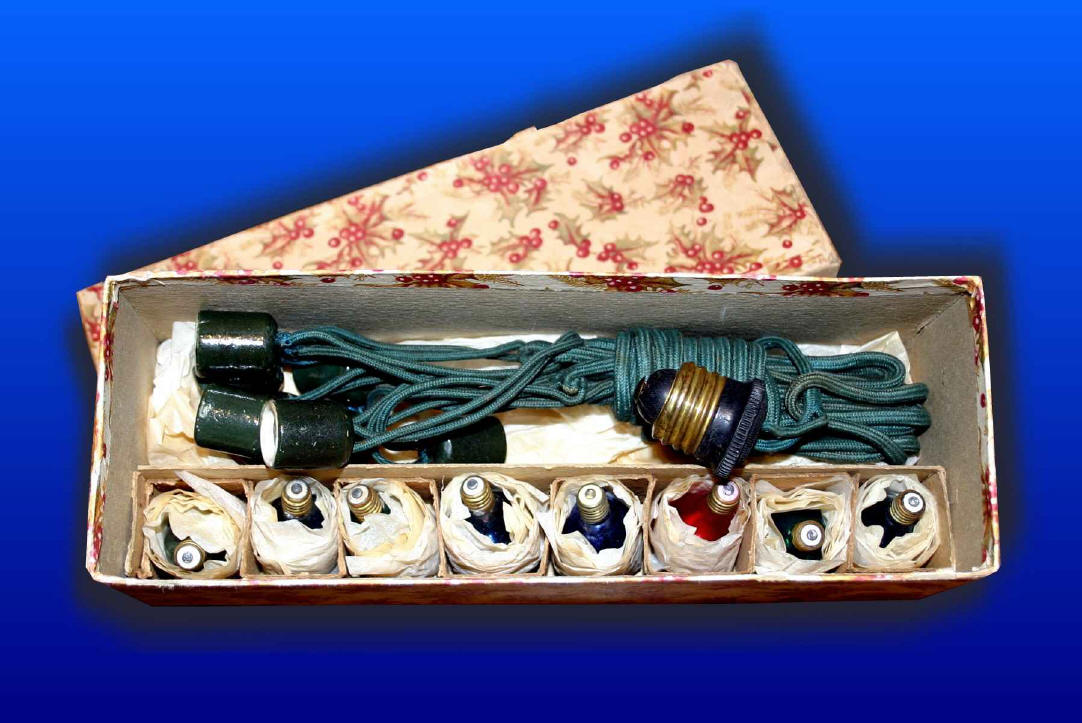
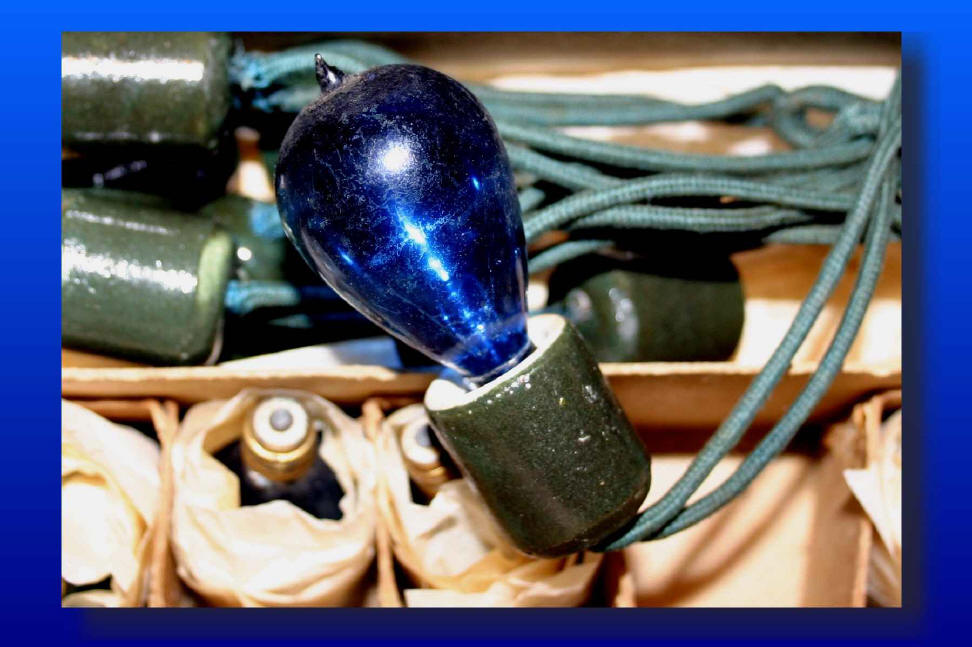
I was recently able to add this wonderful outfit from Peerless to my collection. Circa 1918, the set retains 8 of its original "tin can" type center contact miniature base lamps, which also have ceramic insulators. The filament is horseshoe-shaped carbonized bamboo, and the sockets in the 8 light festoon are green enameled ceramic. The power tap on the silk covered cord is the non-adaptable screw in type. This Peerless Company is not the same outfit that made Christmas lighting products from 1927 until well into the 1960s. The "tin can" type center contact lamps are very early, and of American manufacture. Many of these lamps had oval paper stickers on them, indicating their voltage and light output, measured in candlepower. These lamps are 1 CP, and 14 volts. Although this set has the same name as a major maker of Christmas lights (Peerless), the lights pictured here are not from that company, but of an offshoot of The Diamond Electric Company. |
 |
 |
|
 |
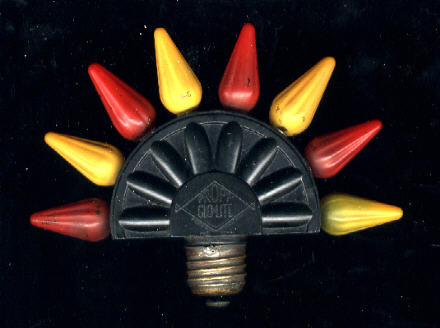
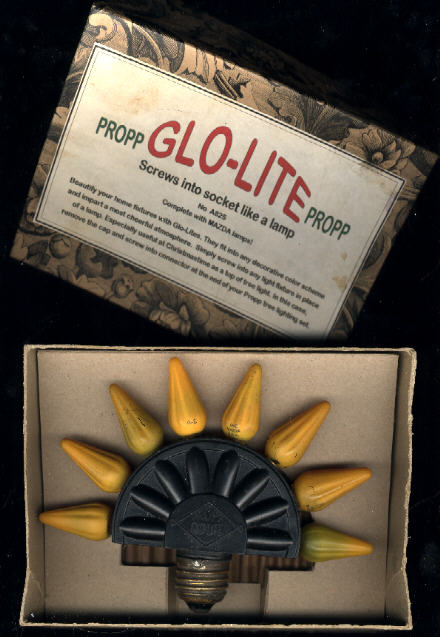
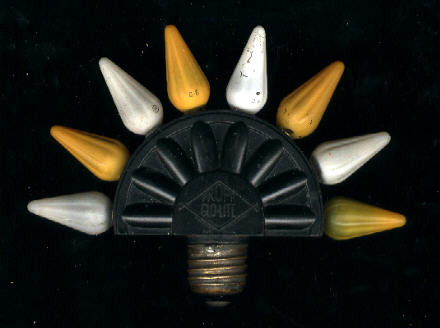
| A very early form of electric tree topper, this 1919 offering from Propp actually was intended for use as a decorative feature in wall lamps. It was offered as shown in one of three color schemes: Sunset (far left) Starlight (second from left, in box) or Sunrise (third from left). When it was discovered that it could also be used as a topper, the Company re-boxed it in a package with a Christmas holly motif and sold it with the lamps as shown in the far right box, and advertised it as the Propp Glo Lite Rainbow Tree Topper. It was actually a great marketing idea- selling four different products merely by supplying different colors of lamps with it. | |||
 |
 |
 |
 |
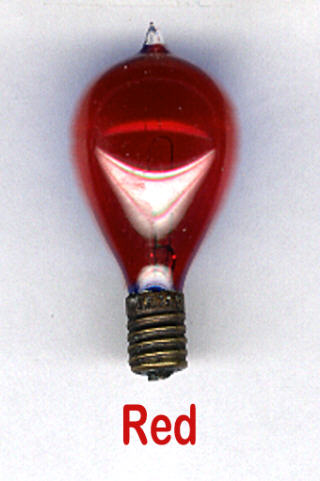
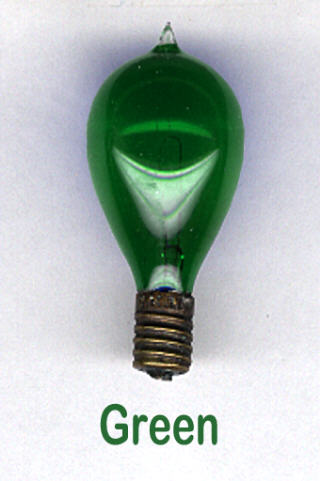
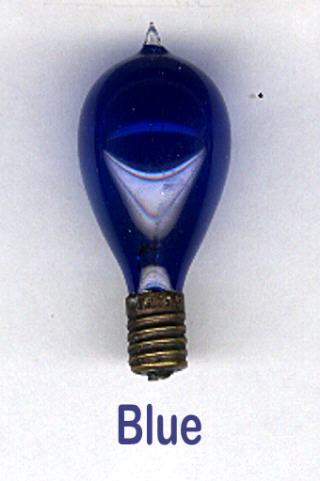
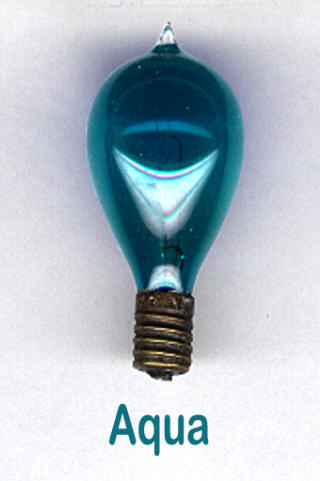
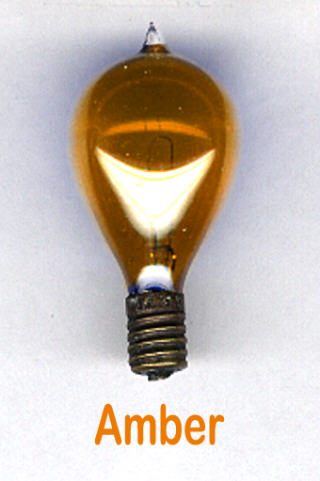
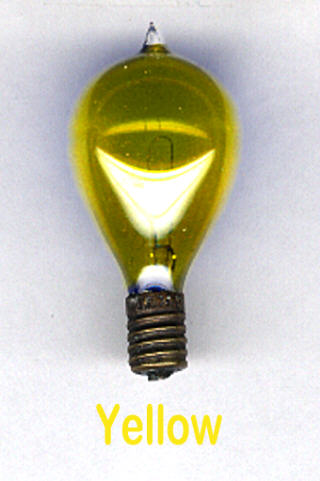
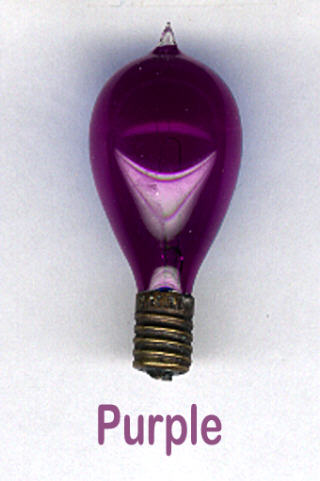
Including clear and white
milk
glass which are not shown, pictured below are all of the known
varieties of true colored glass
exhaust tipped carbon filament Christmas lamps known to exist. Shades
may vary
somewhat from sample to sample, but the basic colors remain true. When
unlit,
specimens appear darker, and the true colors will shine when power is
applied.
The red lamps can be extremely dark in some specimens, almost to the
point of
appearing black. The purple, yellow and amber lamps are the rarest of
all of the
colors, and are very hard to find. All of these examples are Japanese
or German,
have fiber insulators in the base, and are circa 1912.
|
||||||||
|
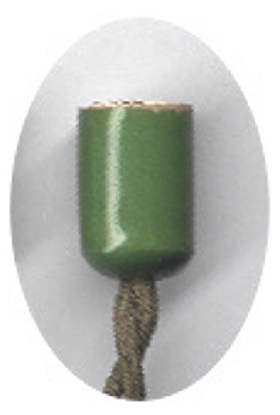
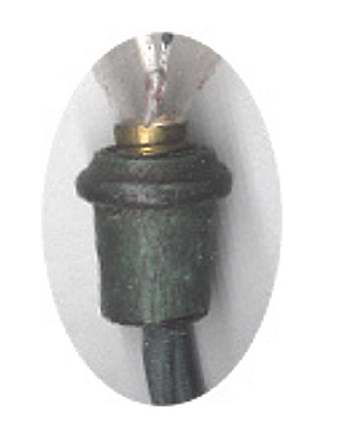
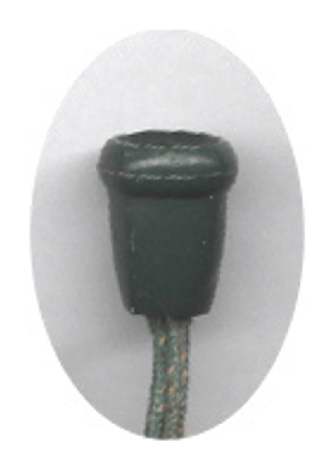
Here's a bit of information on the various light sockets that can be found on sets from this era. Please remember that there are many variations of these sockets, and these illustrations are just a few examples of some of the most common styles to be found. |
|||||
 |
 |
 |
 |
 |
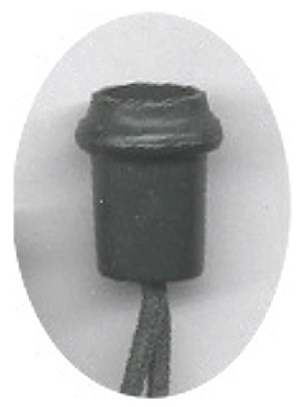 |
| Made of white glazed porcelain, this type of socket is by far the earliest. The example in the picture is from a parallel wired outfit, hence the four wires coming out of the bottom. Series wired outfits are far more common, with just two wires to each socket. You'll find this type of white sockets on pre-1905 sets. | Next in line is the green glazed ceramic socket, used on outfits from 1905 to about 1915 or so. The green color was far more attractive on the tree than the white, but the ceramic was more shatter prone than the porcelain and was easily damaged. | This is a wooden socket, used to my knowledge only on the battery powered outfits. Use of these sockets started in about 1915 and continued until 1935, when the battery sets were no longer manufactured. | An early composition socket, this style is often confused with wood but is much heavier. Composition, the most common form of lighting socket found in sets from this era, was offered in many different shapes. It was the forerunner of today's modern plastic- sturdy and durable, but can be and often was damaged by excessive heat. It is almost always found in green and sometimes (but rarely) in red. | A red and green mottled version of the socket described above. Mottling was popular through about 1940, and was also offered in Bakelite after 1928. | The most commonly seen style of composition socket, this style was used until the mid 1930s. |
|
Note: OldChristmasTreeLights? and FamilyChristmasOnline? are trademarks of Breakthrough Communications? (www.btcomm.com).
|

 | ||||||
| Visit our affiliated sites: | ||||||
| - Christmas Memories and Collectibles - | ||||||
 |

|

|
 |

|
 |
|
| - Family Activities and Crafts - | ||||||
 |
|

|

|

|

|
|
| - Music - | ||||||

|

|
 |

|

|

|
|
| - Trains and Hobbies - | ||||||
 |
 |
 |
 |
 |  |
|

|

|

|  |
|

|
|