|
Note from Editor: Actually tabletop trees were the most common kind in Europe and North America until about 1900. By then, the Christmas tree farms in the United States had been offering bigger trees, suitable for standing on the floor, for several decades. Somewhere between 1890 and 1910 the balance tipped toward floor-standing trees, though both were common.
Most artificial trees, however were still table-top size, including feather trees. With advent of useful electric lighting for Christmas trees, it was inevitable that the companies making the lights would eventually make electrically-lit artificial trees. New materials such as celophane imitated needles better than feathers had, so feather trees eventually disappeared.
Though many other kinds of table-top trees have been manufactured and sold over the years, this page, which Bill Nelson started in the early 2000s, focused mostly on trees made by companies that were already manufacturing lights.
We now return you to Bill's original content, as tweaked and reformatted by George Nelson around late 2004 - Paul.
Lighted table top trees were an important line for
most of the major Christmas lighting companies in the late 1930s and
throughout the 40s and 50s. In fact, a few lighted trees were offered as
early as 1925 (see patent number 1,623,086 in
the Patents Pages), which were simple metal or papier mache cones with shapes cut out for light to shine through, but
they were not big sellers. It took the development of the light
transmitting glass rods, invented by John Frei (patent numbers
1,921,614, and
2,125,906) to bring the multicolored lighted table top tree into its
own. Soon after the Glo Lite trees became popular, NOMA introduced their
line of electrically lit trees, and when they presented Bubble Lites to
the world, it was only a short time before the trees sported bubbling
lights upon their branches. Paramount/Raylite had been selling lit
tabletop trees since 1937, and when they began selling their version of
bubbling lights in 1947, soon offered bubble light trees as well. Here are
some examples of what was available over the years:
|
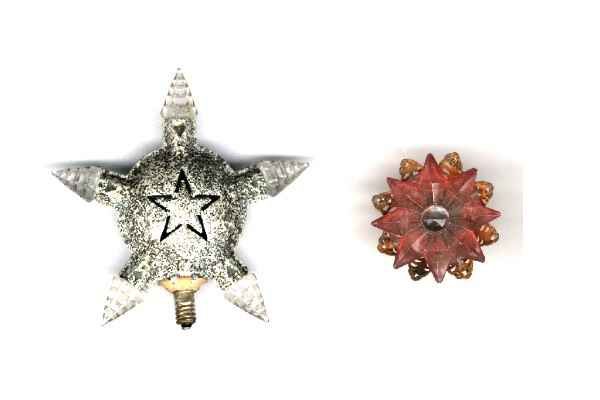
In their 1937
catalog, Paramount pictured this tabletop sized bottlebrush tree,
complete with a Kristal Star topper and their well known "Rosette"
type lights. The catalog description reads as follows: "Snow Covered
Tree, illuminated by eight Rosette lamps, with an attractive Kristal
Star on top. The tree is dark green, covered with glistening snow, set
into a well matched base that is finished in Chinese red. Different
and individual." The collector today will find the lamps are
plentiful, but I have never seen a surviving example of this tree.
|
 |
|
Kristal Star
Tree Topper and Rosette lamp as used on the Paramount bottle
brush tree. |
|
 |
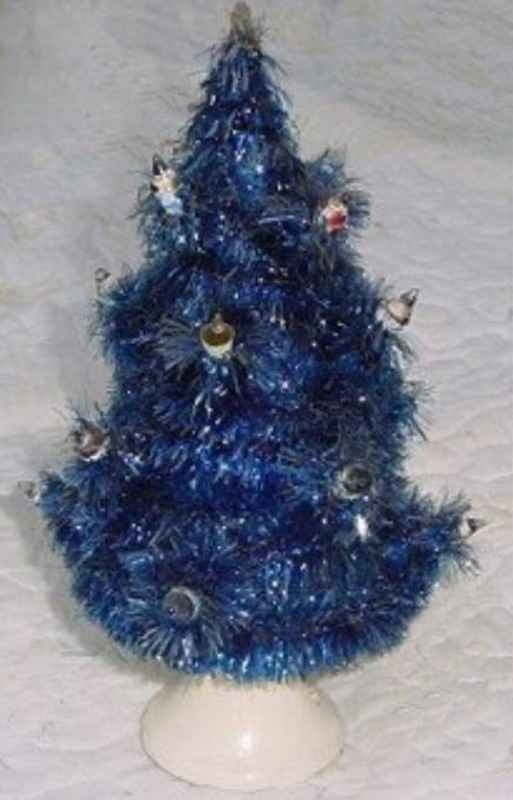
| Here is a very
early version of the GloLite tree. This one is from the collection of
Chris Cuff, and is made of blue cellophane rather than the more usual
Visca. Quite small at only about 10"
tall, the tree body is cardboard, and the little lights are glass
"globs" attached to the ends of cardboard cones. The color is on the
bottom of the glass, and everything is lit from inside with a 10 watt
Mazda bulb in a "Deal" brand socket. The socket is permanently
fastened into the white plaster base with tar. This tree is circa
1936. |
 |
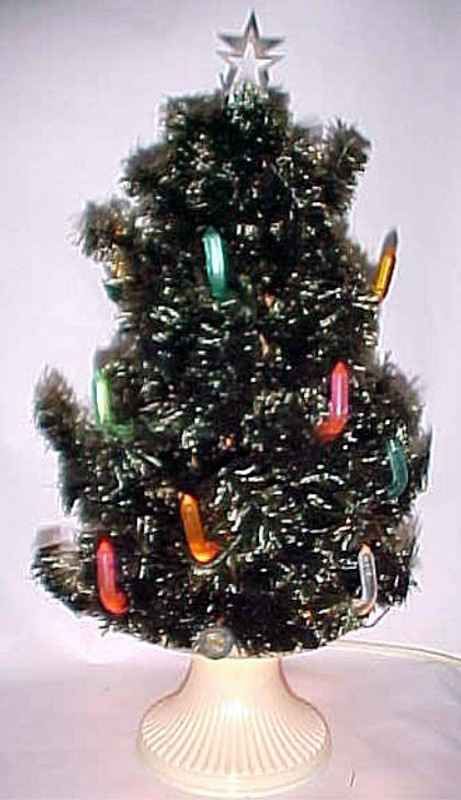
| Here is a small,
GloLite tree, circa 1948. All of the multicolored plastic rods are lit
from within by a single standard base 25 watt light bulb. The base is
white plastic, and the form under the
Visca tree branches is cardboard. Earlier versions of this tree,
made before 1940 or so, used glass rods instead of the plastic. |
 |
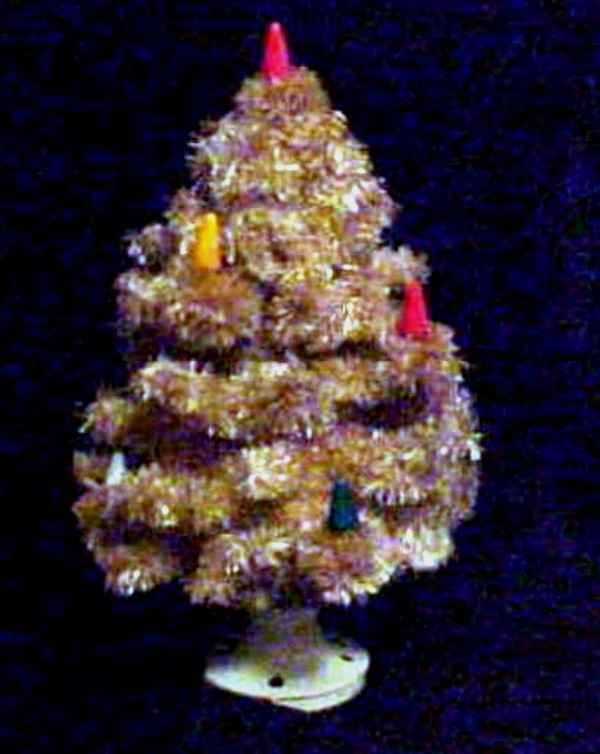
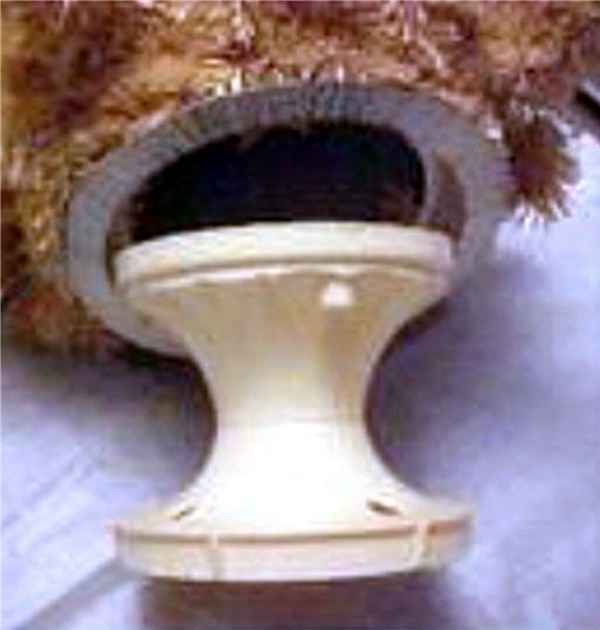
| This early
offering from NOMA is circa 1941, and is a simple 14" high artificial
tree with nine miniature base series wired light sockets. The tree
came with 10 cone shaped lamps in assorted colors. The base is white
plastic, and the close up photo shows how the cardboard cone forming
the tree fits onto it. Originally, the little tree was a bright, pure
white, but time has taken its toll and the tree is now a soft beige in
color. |
 |
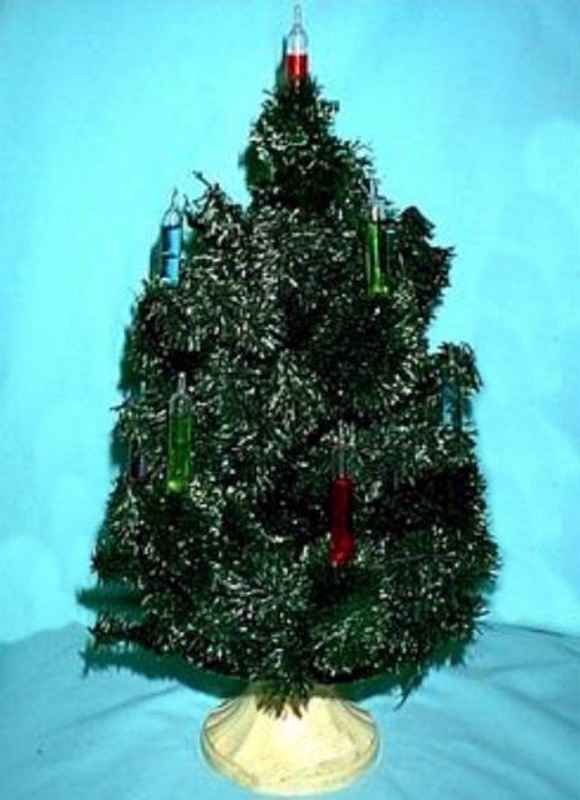
| Here is an example
of one of the first bubble light trees available. This is from NOMA,
and is circa 1946. Instead of having complete, individual bubbling
lights on the tree, the entire unit is heated and lit with a single 25
watt bulb. The base of the tree is a metal cone, and the bubble tubes
simply fit into slots in the cone. The advantage to this arrangement
is that the unit could last virtually forever, as one would only have
to replace the single internal lamp when it failed. this is a very
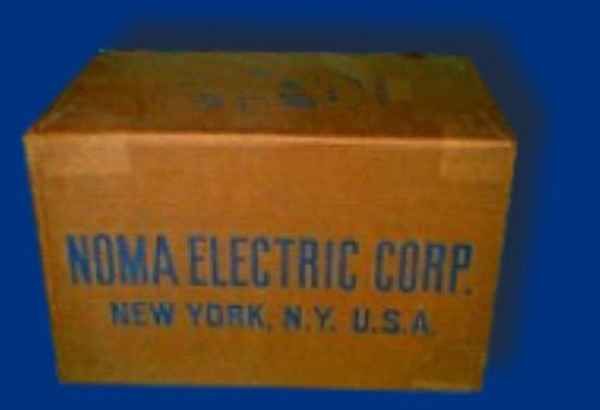
hard to find bubble light tree. All of the NOMA electric trees came in
simple non-decorated corrugated boxes like the one shown here. The
Paramount/Raylite Company also offered a similar tree. |
 |
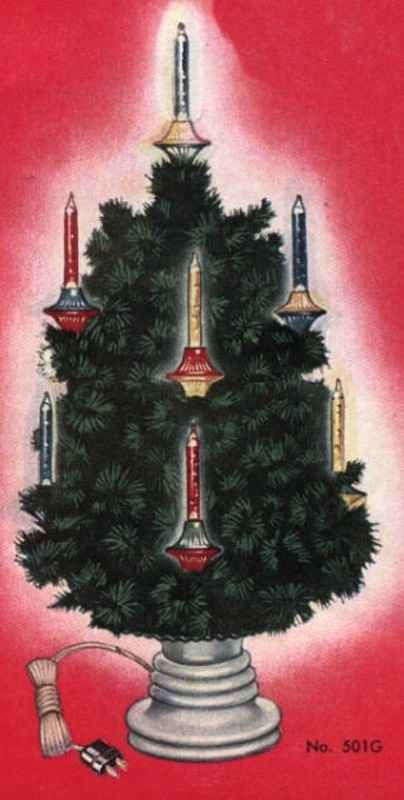
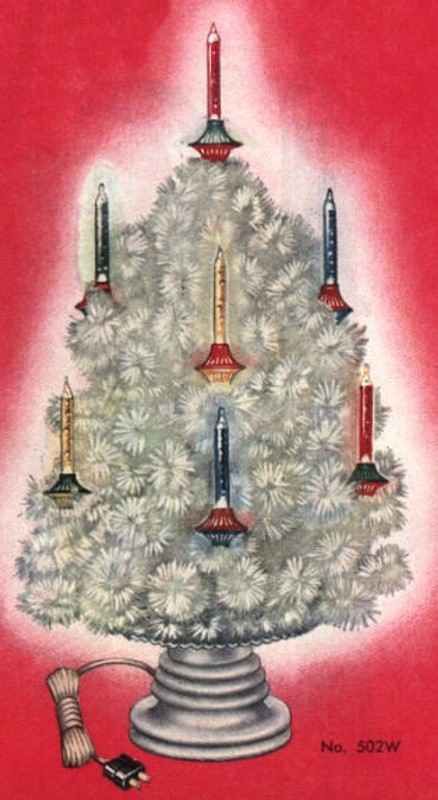
| From 1948, these
NOMA bubble light trees feature 9 of the "new" saucer style bubbling
lights. These lights were series wired, so the failure of a single
lamp caused the entire tree to go dark. The foliage on the 18 inch
high trees is made of Visca, a soft plastic-like material that sadly
becomes brittle with age and eventually sheds. These pictures are from
the 1948 NOMA catalog. |
 |
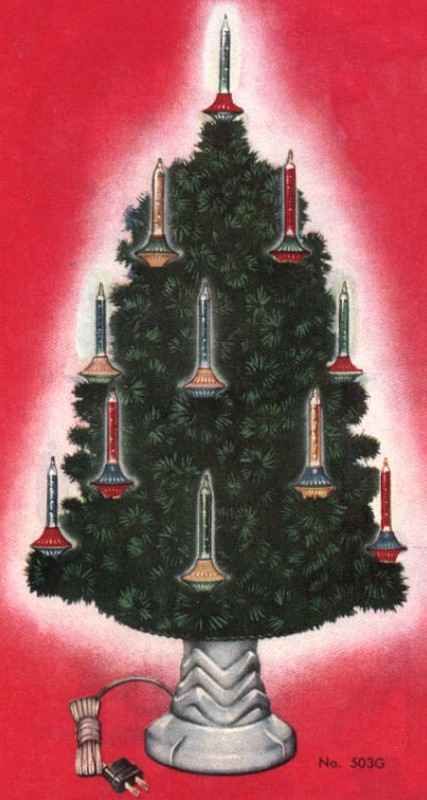
| Also from the 1948
NOMA catalog are these 18 light trees, identical in construction to
the ones above except for their size (26 inches high). These larger
trees are both more desirable for collectors and much harder to find. |
 |
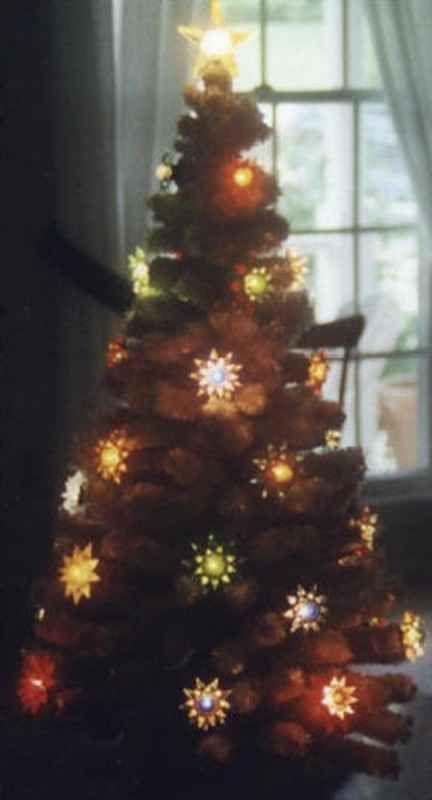
| This is a large
NOMA 32 light tabletop tree shared with us from the collection of Jim
Sloss. Displayed upon the tree is part of Jim's large collection of
glass Matchless Stars, including the exceedingly rare Matchless Star
tree topper. Trees like this, with horizontally mounted sockets
instead of the more traditional vertically mounted ones are very hard
to find today, and were originally intended to hold small round G-4
lamps. When lit, the little lamps would resemble holly berries. The
picture was taken in a darkened room to make the fabulous colors of
the lights more visible, but notice that this tree is a beautiful
white example, and in extremely good condition. So many of these Visca
covered trees are now sadly discolored and shedding badly, but this
example retains all of its original charm and grace. The tree is circa
1949. |
 |
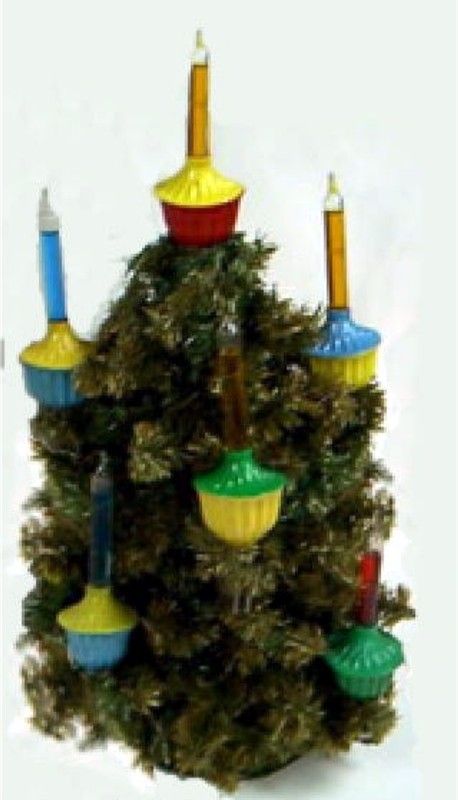
| This tree is a
hard to find multiple wired example from NOMA, and is circa 1949. The
unit has nine candelabra base bubble lights, and contains a very hard
to find solid color base bubbler (the green light on the bottom right
of the tree). It was common practice for NOMA to mix the colors on
their bubble light bases, and only rarely would a solid color example
slip through the factory. |
 |
| Also from the
collection of Chris Cuff is this circa 1950 bubble light tree from
Royal. This is an eleven light tree, wired in the usual series
configuration. With eleven lights in the series, the lamps will have
an extremely long life, and Chris reports that all of the lamps appear
to be original. Quite a feat, considering that this tree is 51 years
old! Sadly, the Royal Christmas division of their manufacturing plant
burned in 1955, and the company sold their molds and other salvageable
equipment to NOMA and a couple of other companies, choosing not to
remain in the Christmas business. Royal still makes non-decorative
electrical items to this day. |
 |
End of Section
Welcome Page
TABLE OF CONTENTS
|