|
Lighted figures and novelty items were
introduced to the American Christmas lighting market almost as soon as
were Christmas lights themselves. A wide variety of items were offered, a
few of which are represented, in a rough chronological order, on these
pages.
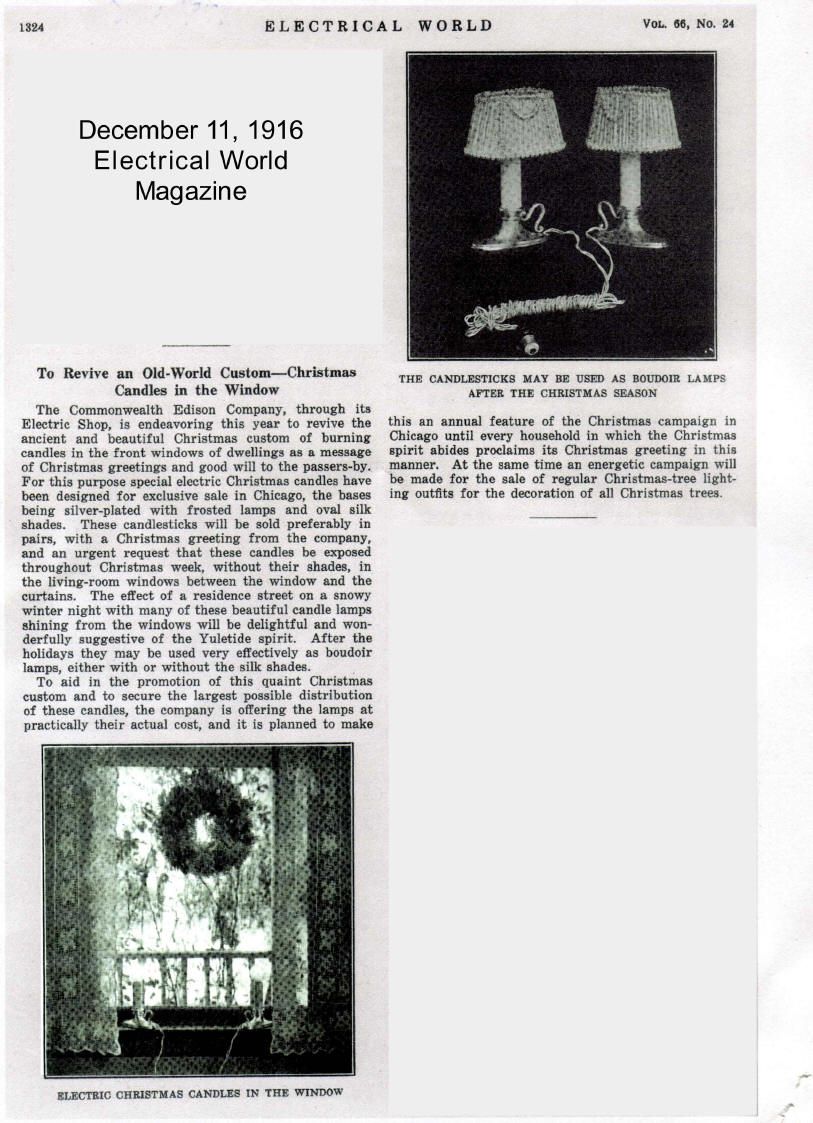
| December 11, 1916: An article appeared in the December issue of
Electrical World Magazine, touting the use of what were actually
boudoir lamps in the front windows of homes during the Yuletide
season. The lamps pictured served a double purpose, as when used
without shades and placed in the window, they appeared from the
street to be candles. The lamps were sold by the Commonwealth Edison
Company in Chicago, Illinois, at "practically their actual cost." |
 |
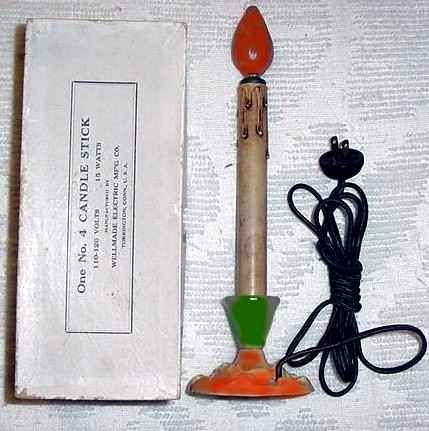
| ca 1920:
This iron based candle from the Wellmade Company, is a typical
example of window candles made especially for Christmas use, despite
the rather "un-Christmassy" colors of the painted base. The heavy
iron base served to keep the unit in place on the window sill. From
the collection of Chris Cuff. |
|
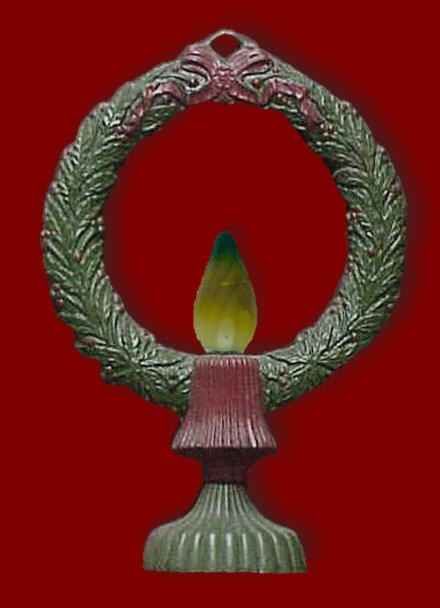
| ca 1922: Cast iron decorative light fixtures
like this example were popular in the 1920s. This particular wreath
was advertised as a hearth light, and was actually sold in pairs for
that purpose, although some catalogs also listed them separately.
The unit has an eight foot cloth covered power cord, and is marked
on the base "Made in USA". The actual manufacturer of the fixture is
unknown.
|
|
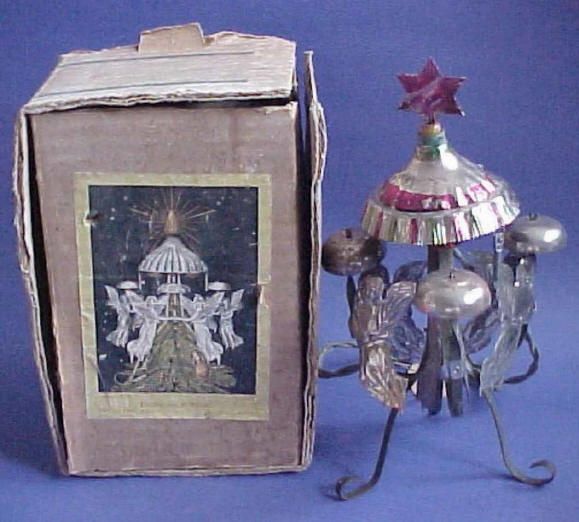
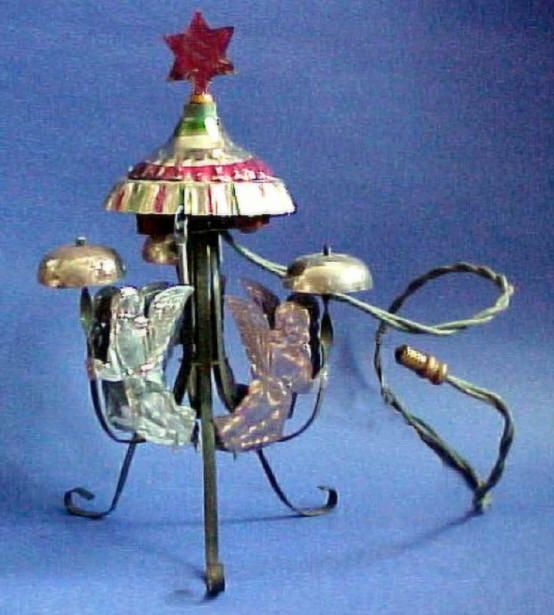
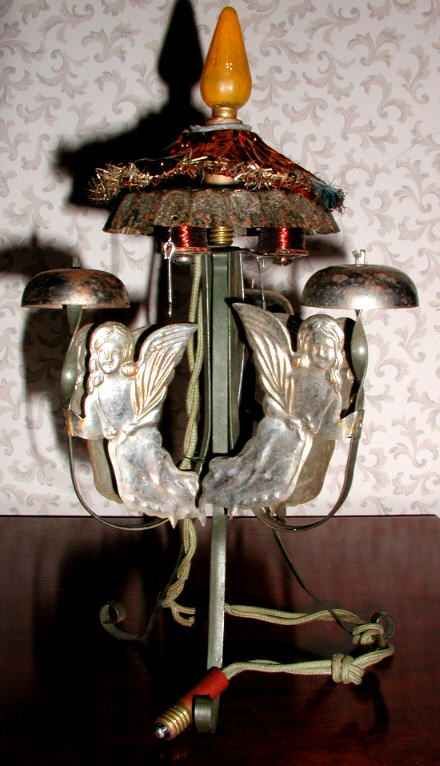
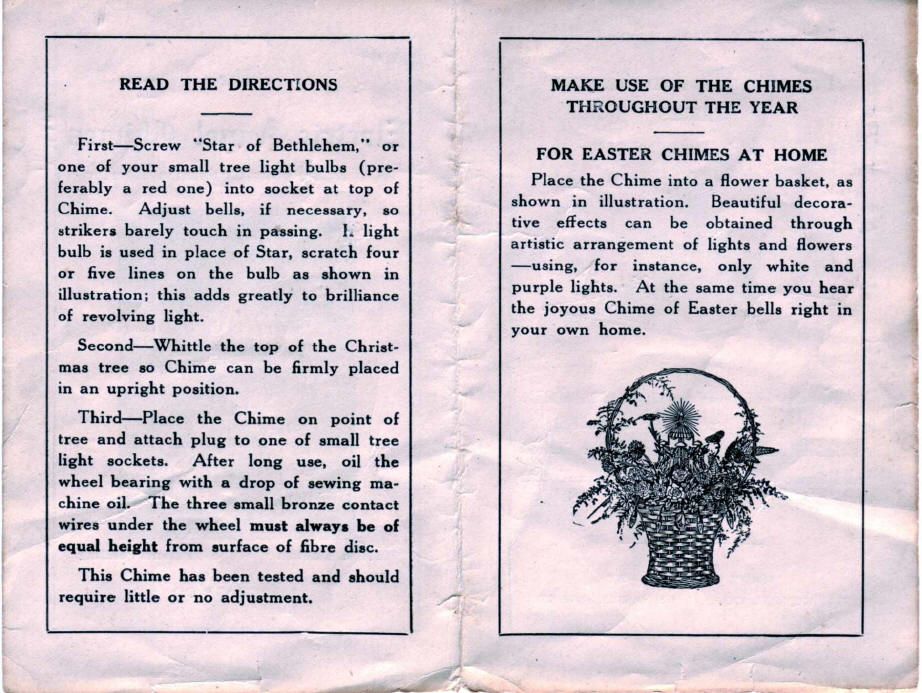
ca 1922-27: This chiming tree topper from
Keydel is intended to plug into a string of lights by removing one
lamp and screwing in the brass and wooden connector in its place.
The top portion of the unit then rotates, causing little hammers to
strike each of the three differently tuned bells in sequence. The
sound produced is most charming. There are at least two versions of
this topper. The earliest is by Keydel, and included a star for the
top that could be substituted for the light bulb, causing the chimes
to run just a little bit faster. The top, rotating part of the unit
was painted in red and green lacquers. The later version, also
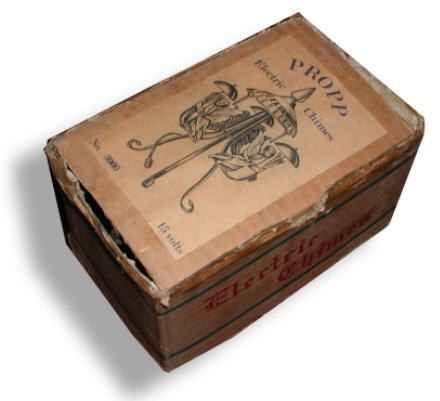
manufactured by Keydel but sold under the Propp name, does not
include the star but has larger coils in the motor to improve
performance. The top of this unit had mica glitter on it. In either
case, the unit did not operate reliably, and often caused the lights
on the tree to flicker as the primitive motor operated. The
unit was discontinued after a few short years of production, but
overstock was sold through about 1927 or so.
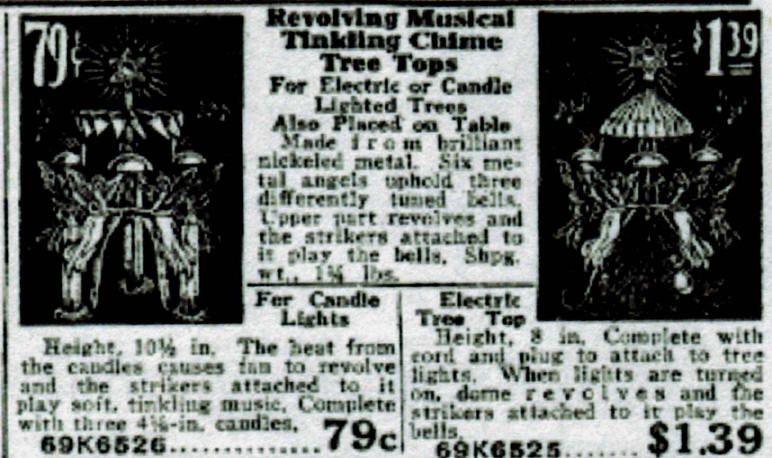
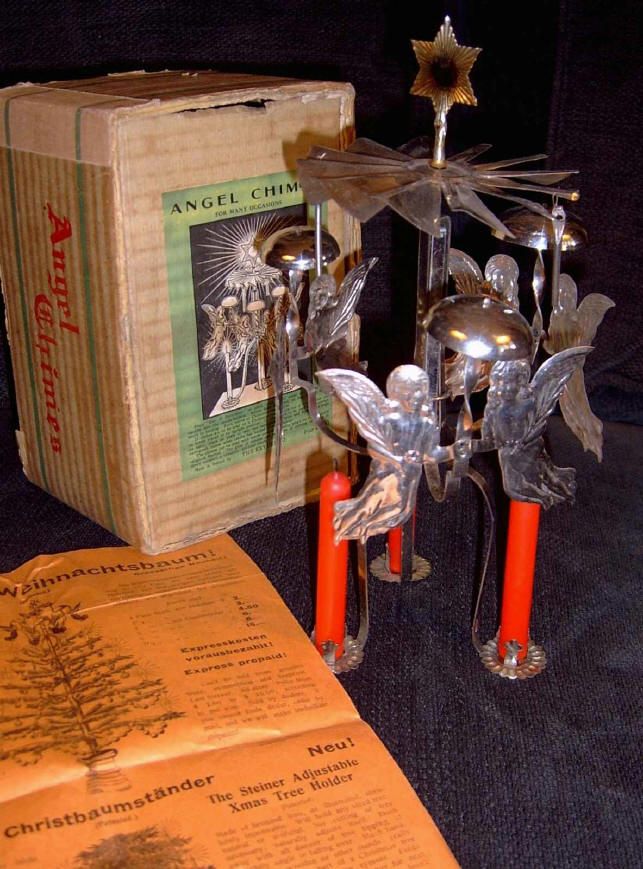
UPDATE: Web site visitor Eric
H. recently wrote to me and shared pictures of a candle
flame powered Angel Chime made by Keydel, almost identical to the
electric powered version. Coincidentally, another web site visitor,
Ross Stoval, sent me a copy of a 1927 Sears and Roebuck Winter
Catalog page. On it are pictured the two versions of the chimes,
side by side. Thanks to both Eric and Ross for their kind
sharing of information!
|
 |
 |
 |
 |
 |
 |
Keydel branded unit,
circa 1922 |
Propp branded unit,
circa 1924 |
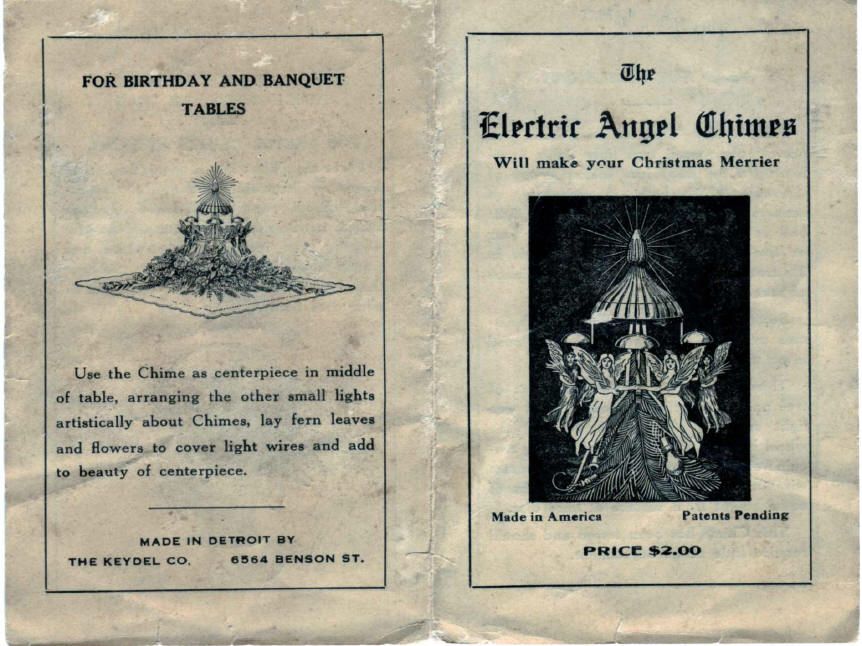
Front and back of instruction booklet |
|
 |
 |
|
1927 Sears
Catalog |
Eric's Keydel Candle Chimes |
|
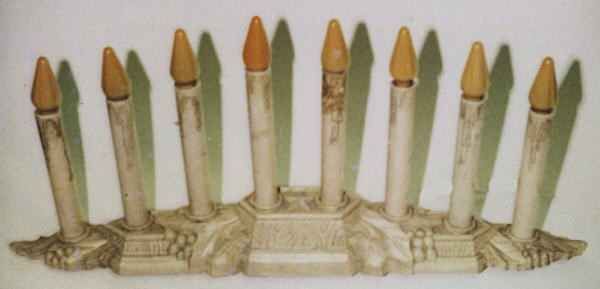
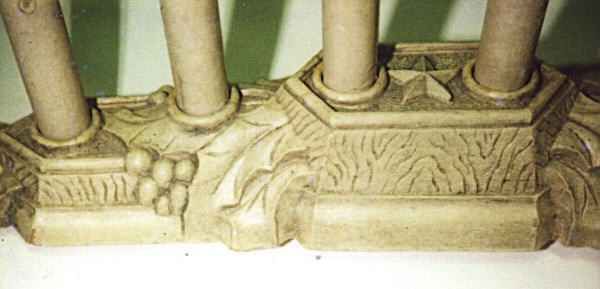
| ca 1925:
Here is a marvelous candolier that is unmarked as to maker. The
power cord is cloth covered two-wire, which dates the unit to the
mid 1920s. The unit is made of the same type of composition that the
early Christmas light strings are made of, but in this case the
material is ivory colored rather than the dark green more often
seen. The candles are made of heavy cardboard. Candoliers like this
were the forerunners of the later plastic window and mantle lights,
but these early units were much more attractive and intricate.
Examples like this are exceedingly hard to find. |
 |
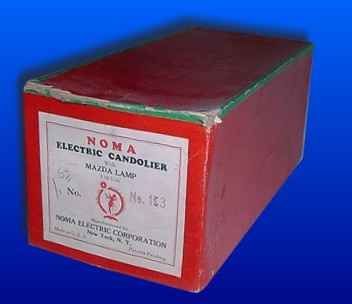
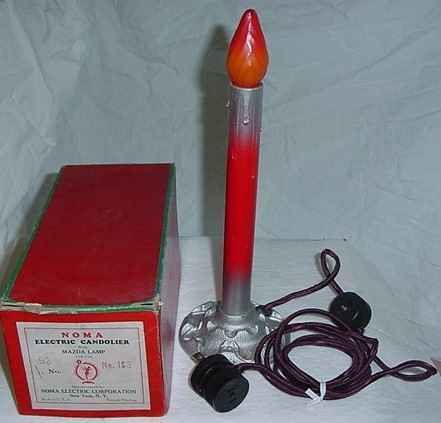
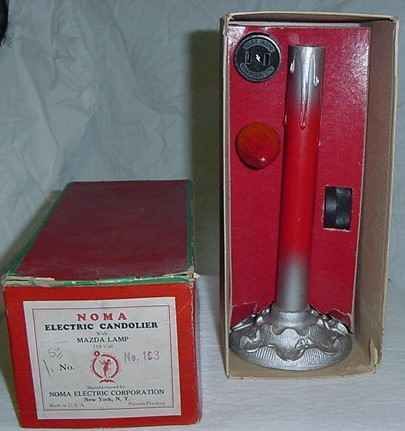
| 1927: This iron
base window candle is marked NOMA, but is actually a Monowatt
product, acquired when that company merged with NOMA in 1926-1927.
As such, this candle is not pictured in NOMA catalogs. (NOMA
over-pasted their label on the original Monowatt tag.) Note the
early use of the Tatchon connectors, which allowed additional
candles to be connected together. This unit, which is very hard to
find, features two of the connectors, one close to the candle base
so another unit could be added to make a pair in a large window, and
the other at the end of the cord so as not to monopolize the single
wall plugs in common use at the time. From the collection of Chris
Cuff. |
 |
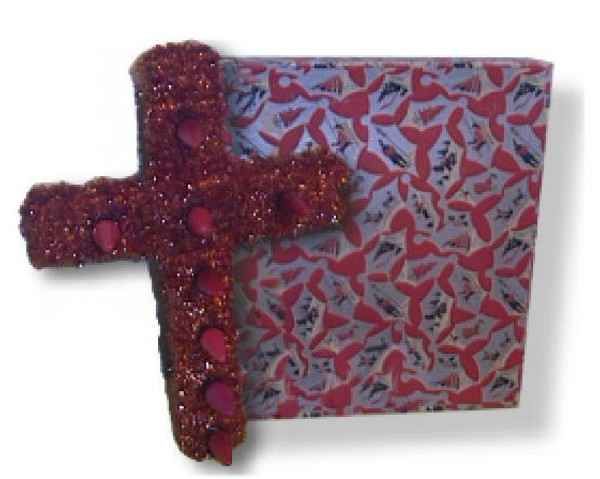
| ca 1935: Manufactured by the Leo Pollock
Company, or Polly, this cellophane-wrapped cross has a cardboard
base and eight miniature base C-6 lamps. It was meant to be hung in
a window or over a porch covered door. |
 |
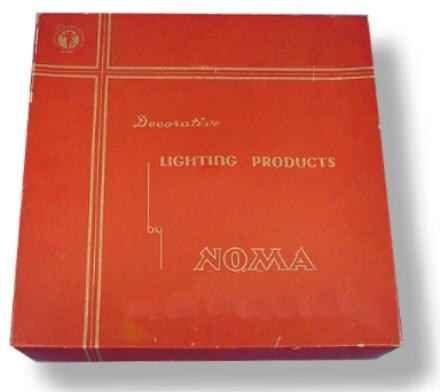
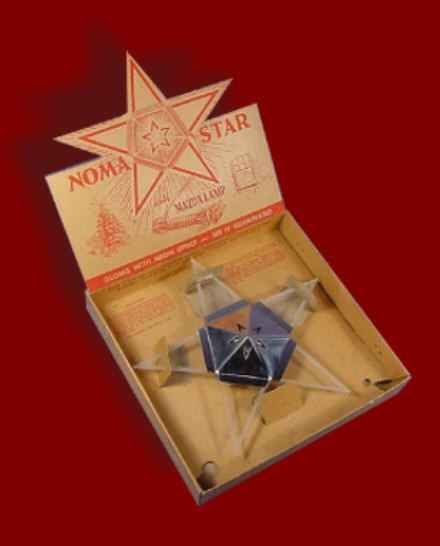
| ca 1938:
A NOMA "neon" metal and glass star, which was quite a novelty for
its time. Lit from within by a single candelabra base C-7 lamp, the
outer edges of the unit would glow with a decidedly neon effect, due
to the beveled and frosted edges of the clear glass star rays. The
center would glow as well from the cutouts in the metal . The star
was provided with a tree-top adapter, or it could be placed or hung
in a window or on a mantelpiece. The star continued to be offered by
NOMA well into the late 1950s, although by that time the star's rays
had been changed to a more cost effective Lucite. |
 |
| ca 1946:
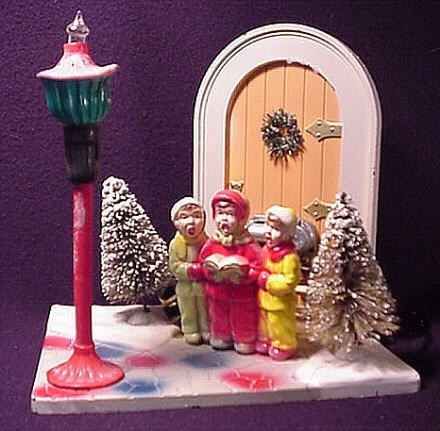
This charming lighted scene of caroling children was sold by NOMA.
The door contains a music box, which plays "Jingle Bells". The
interesting street light is a combination of two other NOMA
products, as it has a glass rod from their earlier (circa 1938)
GloLite electric candle, and base parts from a multiple wired
bubbling light. The distortion and damage to the light itself also
helps us to date it, as the disfiguration is from a fire retardant
additive that NOMA added to their electrical plastics in the late
1940s, and the chemical actually serves to destroy the plastic over
time. This scene is exceedingly difficult to find in good, complete
condition today. |
 |
| 1946
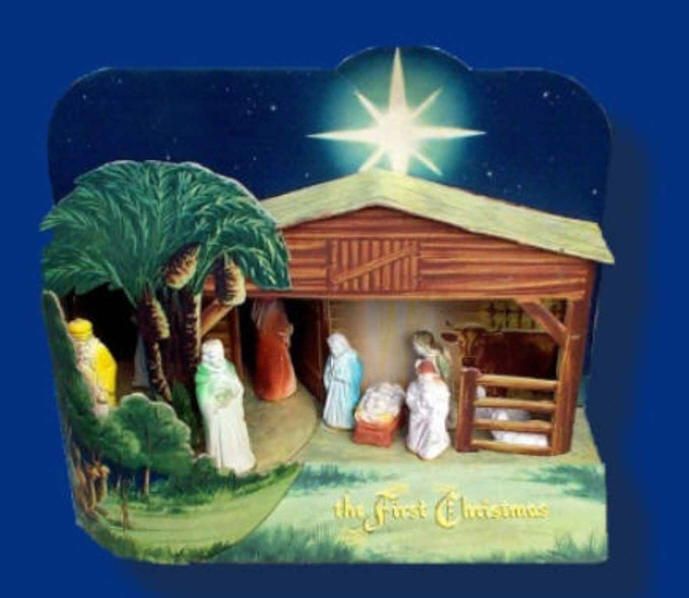
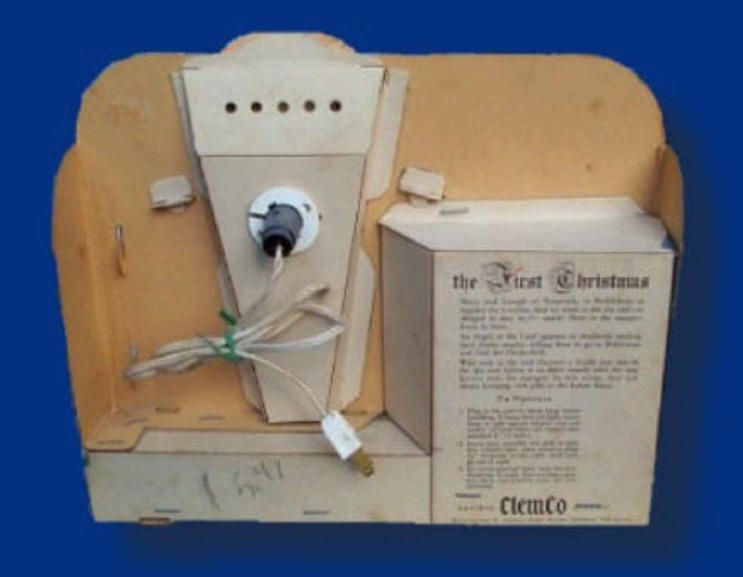
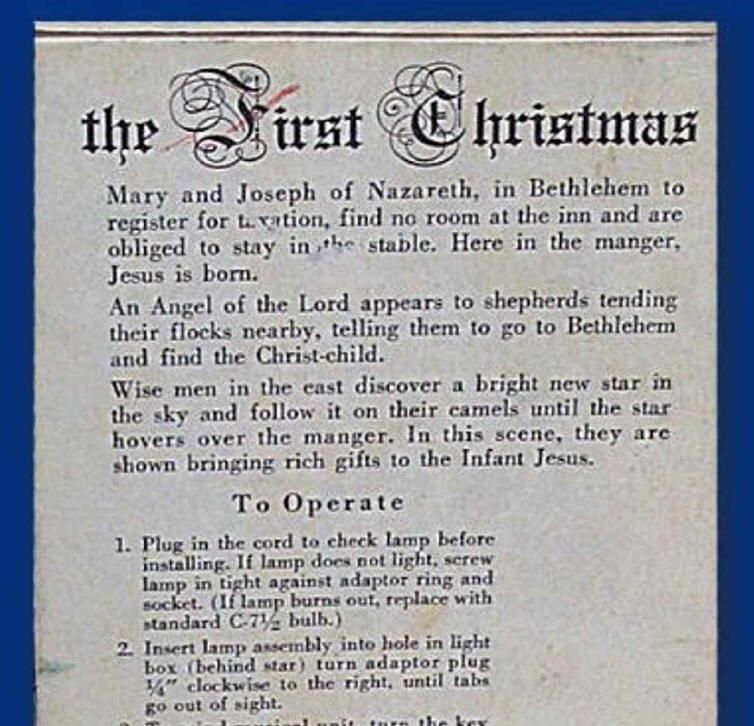
This delightful 1946 cardboard Nativity scene from ClemCo is lighted
by a single C-7 lamp, and features a music box which plays "Silent
Night". The Wise Men rotate on a platform nearby the Christ Child,
giving the impression that they are passing by, presenting their
gifts. Original selling price was $5.49. The figures are made of
plaster. This is a very hard to find display, particularly in good
condition like this example. |
 |
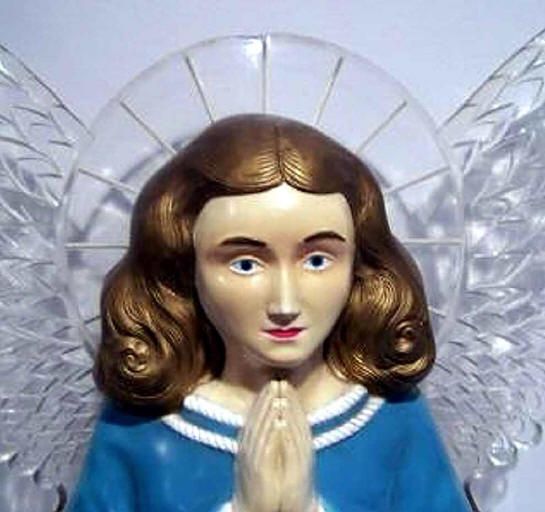
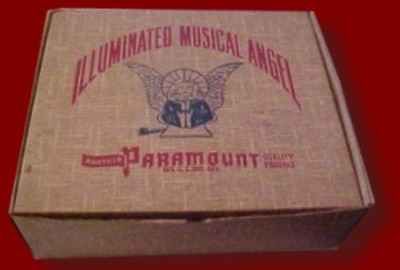
| ca 1946:
One of the prettiest lighted novelty figures and also one of the
hardest to find, this musical angel could be used as a stand-alone
night light, a tree topper or a wall plaque. Along with the light, a
music box accessible in the back plays a nicely arranged version of
"Angels We Have Heard on High". The product is from Paramount. |

|
|
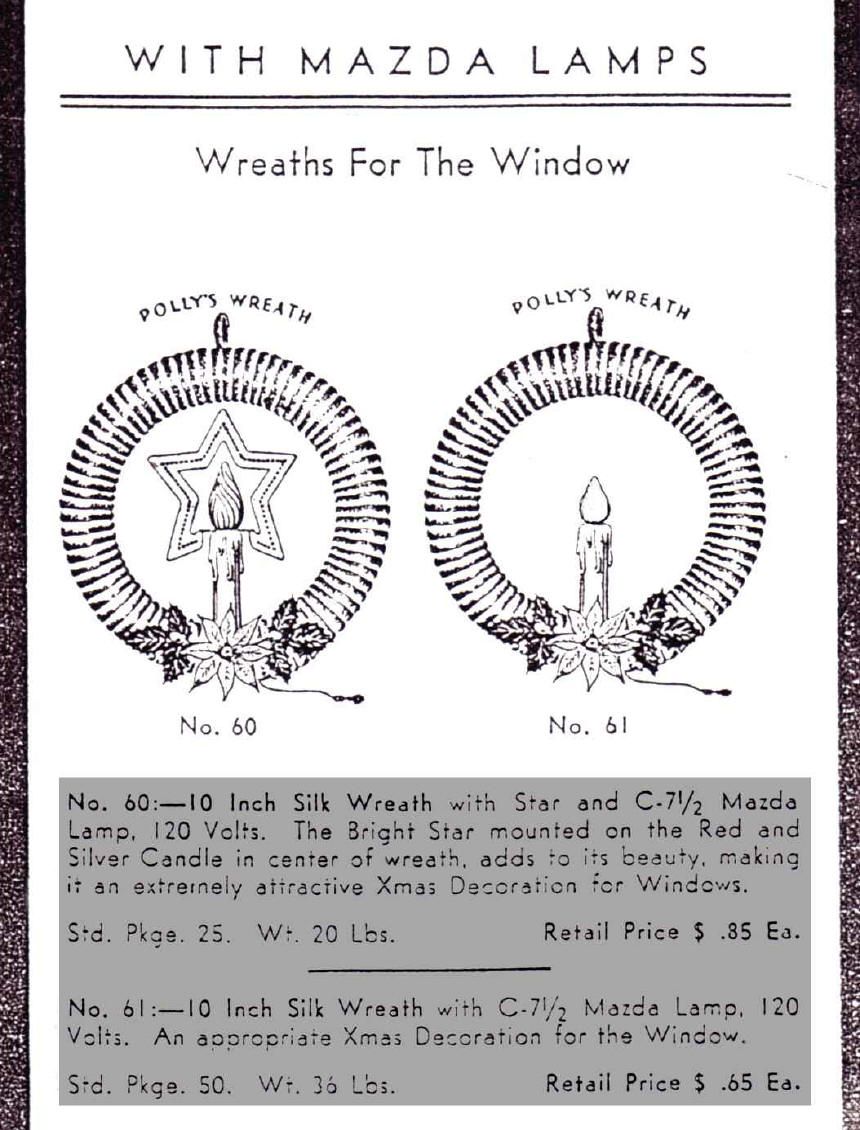
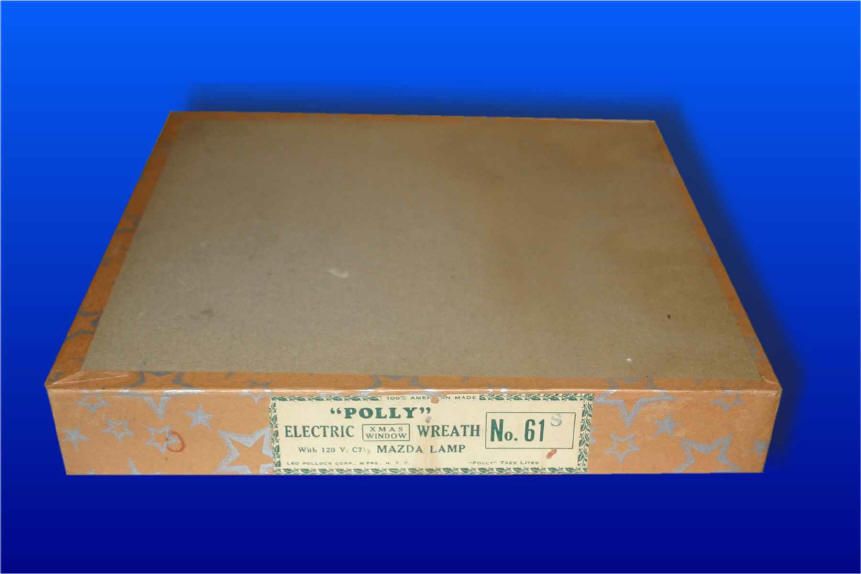
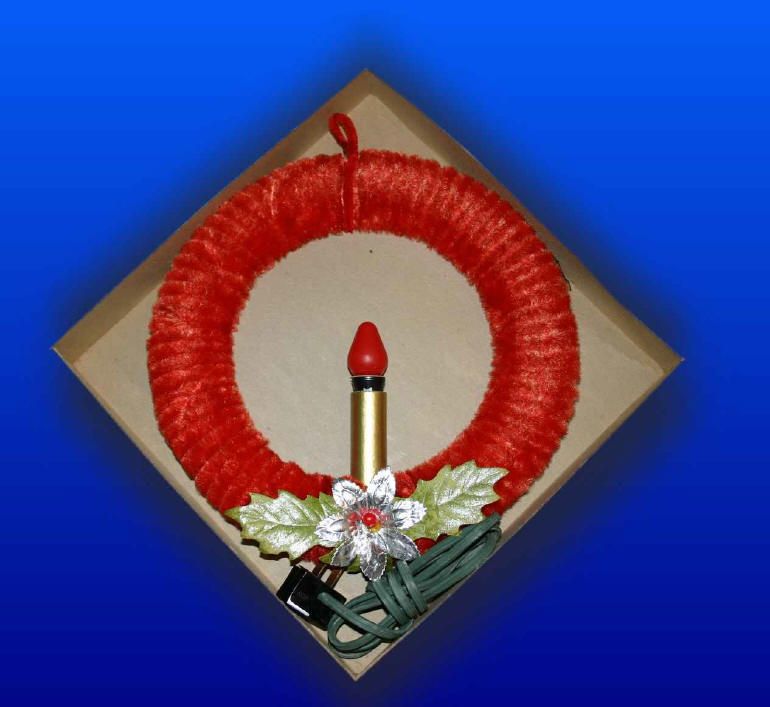
ca 1946: A postwar offering from Polly,
this wreath joins the collection as a kind gift from a friend. In
pristine condition, the piece retains all of its original color and
charm. A vintage 1937 Polly catalog shows this wreath, number 61, in
a earlier version. Notice that this later production model has a
candle without the artificial drips, and that the cord is now rubber
instead of cloth covered. The box is quite plain, and has side
decorations only. This seems to indicate that the wreath was sold in
bulk for commercial decorating purposes rather than consumer use.
The decorative paper matches that of lighting outfit the company
produced for bulk sale for use as decorations in large department
stores. |
 |
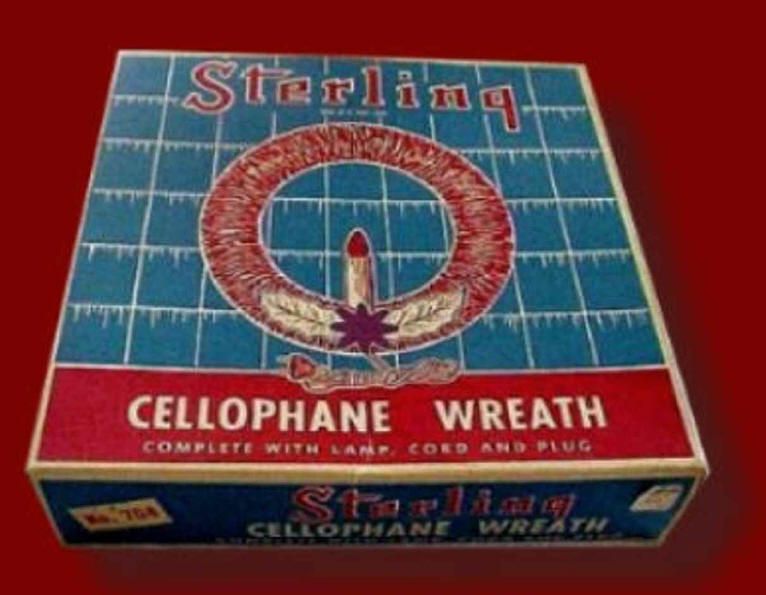
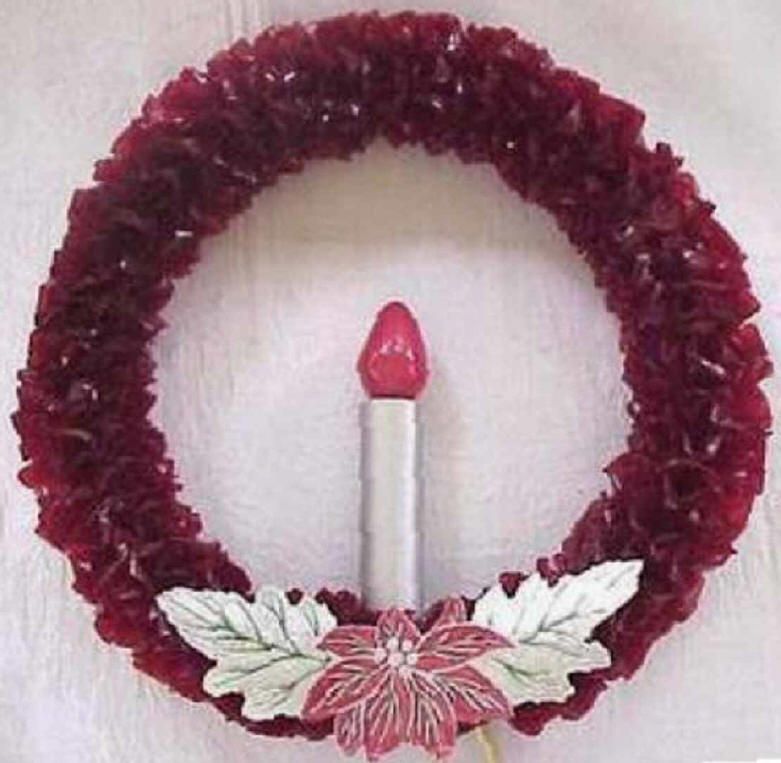
| ca 1947:
Extremely popular during the late 1920s and throughout the 1950s,
cellophane window wreaths like this one from Paramount/Sterling were
offered by all of the major Christmas lighting manufacturers. The
earliest wreaths were chenille, while the later products featured
"sparkling cellophane" like the example pictured here. Both types of
coverings, for the most part, have withstood the test of time quite
well. This wreath is from 1947. |
 |
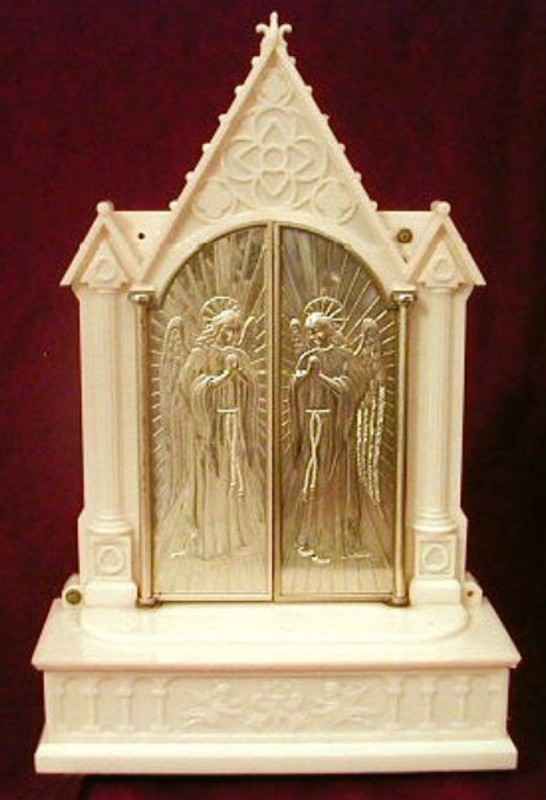
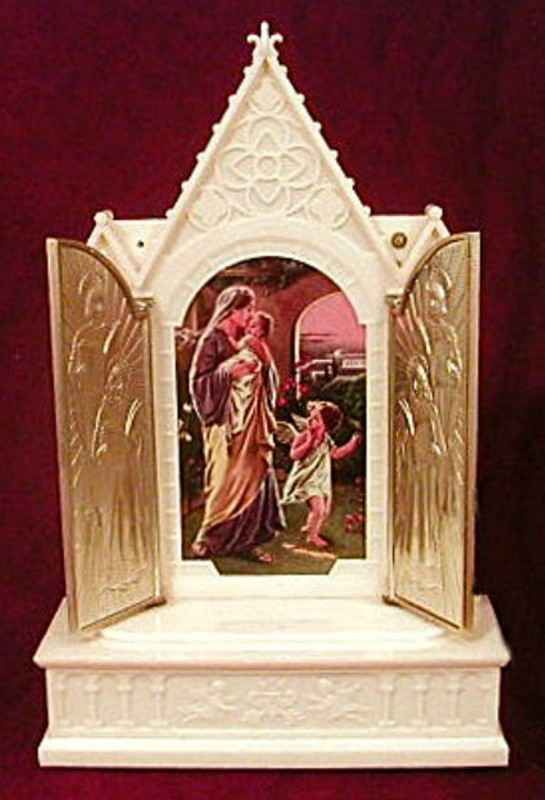
| ca 1948: Here is a unique offering from
Paramount/Raylite. The "church" is lighted and incorporates a music
box which plays "Silent Night", while the church doors open and
close slowly, revealing the lighted painting of the Madonna and
Christ Child being led by an angel or cherub. A most charming middle
century novelty item, made of heavy ivory colored plastic. |
 |
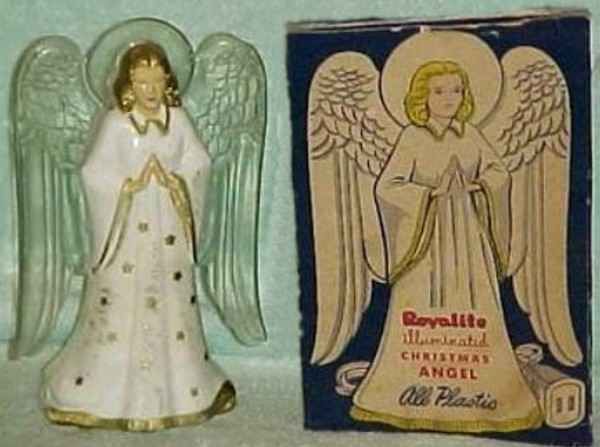
| ca 1948:
This angel by Royal could be used as either a tree topper or a free
standing figure. The clear wings are heavily embossed, and when
lighted from within gave a most unusual effect, in many ways quite
similar to the NOMA "neon" star shown above. |
 |
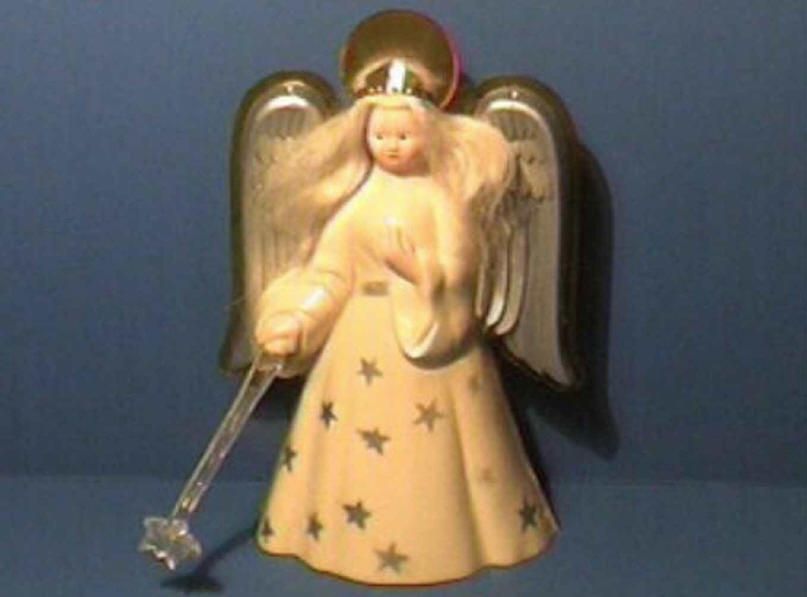
| ca 1948: NOMA first offered this hard
plastic lighted angel with a wand in the early 1940s. It can be used
both as a tree topper and a stand alone light. Variations of this
unit sometimes included molded plastic hair instead of the
individual strands of doll hair as featured on this example. This
unit is from the late 1940s. |
 |
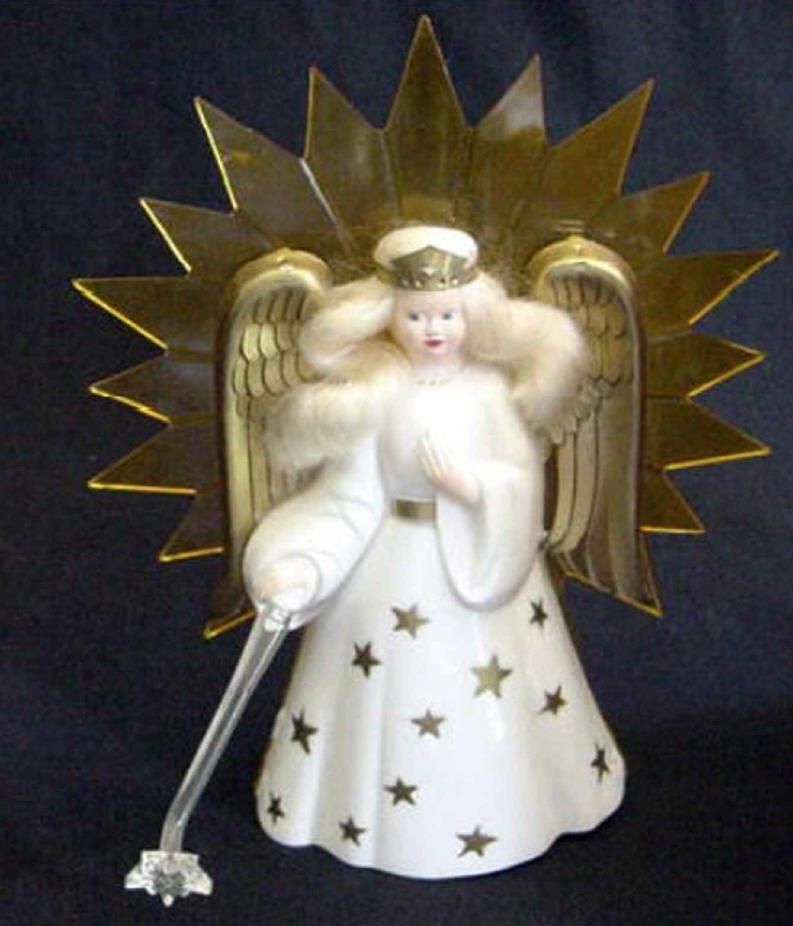
| ca 1948:
This variation of the NOMA treetop angel eliminates the halo around
the figure's head, but has a starburst mounted to the back instead,
which glows with a warm amber color when lighted. This example was
called the Glow Lite Treetop Angel. |
 |
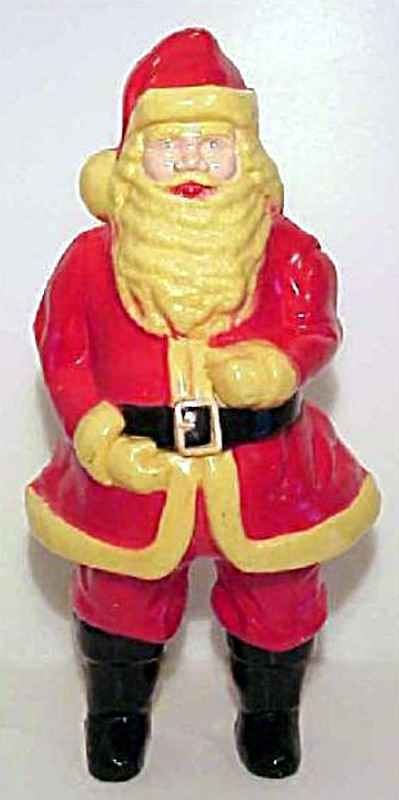
| ca 1948:
Many companies offered Standing Santa figures like this one, lighted
from within by a single C-7 lamp through a hole in the back. This
example is from Miller, and is 24" tall. These plastic figures are
often misidentified as being made of Celluloid, but they were
actually typical late 40s era hard plastic that has yellowed over
the years, giving the material the off-white appearance and
brittleness often attributed to celluloid. |
 |
Welcome Page
TABLE OF CONTENTS
NEXT
|