|
|
|
|
|
|
| Date | Manufacturer | Notes | Outside of Box | Inside of Box |
| ca 1929 | Real Lite |
This outfit specifies the use of Japanese lamps, and is equipped with colorful "snow tip" lamps that are painted in two different colors, fading into each other. |
 |
 |
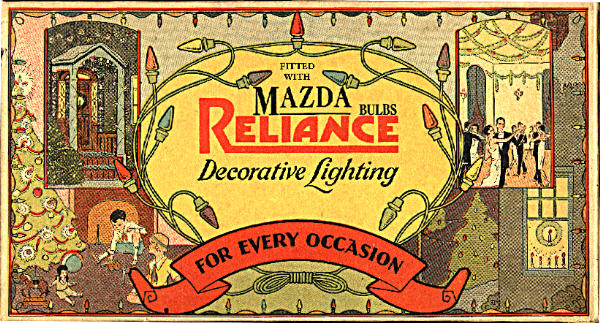
| ca 1929 | Reliance |
The string is an early example of Bakelite sockets. The earliest Bakelite sockets were mottled with red and green, while later examples are usually solid brown or black in color. |
 |
 |
| ca 1929 | ClemCo |
This is ClemCo's earliest C-9 outdoor outfit, and is a difficult box to find. The light string sold with this set has a brand name of Meteor, and is a high quality Underwriter's listed cord which was equipped with the more expensive General Electric Mazda inside colored lamps and clips for positioning the lights. |
 |
 |
| ca 1929 | NOMA |
This outfit by Novolite is actually a NOMA set. It is unclear why NOMA chose such a similar name as their own to market this less-expensive set, which is usually found equipped with Japanese lamps. NOMA usually chose a very dissimilar name (like Glolite, for example) when selling cheaper outfits. Adding a bit to the mystery, this particular box art was created solely to market the seven light outdoor set, which is unusual. More often, companies would merely adapt existing box art to accommodate the larger sets, saving on production costs. |
 |
 |
| ca 1929 | Thomas Imports |
Produced by Thomas Imports, or Timco, this set always came from the factory with imported lamps. The light strings on both of these outfits is lacquered cotton, the earliest form of weatherproofing. As the string aged, the lacquer would harden and become stiff, making the set unusable. Storage in extremely warm places such as attics or garages added to the stiffening problem, and later outdoor sets would use rubber coated wires to alleviate this problem. All of these sets remain quite flexible due to the fact that they were stored indoors and away from heat and humidity. |
 |
 |
|
Here is a very interesting indoor lighting set from Gacor, a small appliance and electrical novelty company. Utilizing eight intermediate base C-9 lamps wired in pairs and called a "Multiple Twinkle Set", the outfit has a control box (pictured below, third image from the left) that randomly flashes each of the four pairs of lights. This is the first outfit on the market that would allow a true "twinkling" effect, as other twinkling lights of the period flashed the entire string on and off at once. The set was offered first in 1922 using miniature base C-6 lamps, and later in 1928 with the intermediate base C-9 lamps as shown above. Both types of outfits were sold through 1932, when the effects of the Depression made the $6.00 sets too expensive to sell. The price for the set is printed on the inner flap of the box as pictured above. The control box has a red switch that allows the lights to either randomly twinkle or burn steadily, and uses a simple bi-metallic system to flash the lights. This system has two strips of different metals wired into each pair of light strings. As current passes through these strips, one of them heats up a bit and curls away, breaking the circuit. It cools again almost instantly, again closing the circuit and lighting the lamps. Different lengths of wire for each socket allow the lights to be easily distributed about the tree for the most pleasing effect. It is unusual for C-9 intermediate base lamps to be specified for indoor use, as they were invented specifically to be durable and weatherproof outside, but this outfit is decidedly not weatherproof and could not safely be used outdoors. The system is quite ingenious and well made, and really produces a nice effect on the Christmas tree. Note the unusual metal sockets in the set as shown in the picture below. |
||||
 |
 |
 |
 |
 |
|
Here's another example of a twinkling outfit, this one by NOMA. Circa 1929, the twinkling device is practically identical to the Gacor set above, even down to the metal sockets. I believe it is safe to assume that NOMA either purchased their twinkling devices from Gacor, or by the time this set was made, NOMA had purchased the Gacor company or patent rights. This NOMA box is very typical of the other sets that were sold by the Company, with the only difference being the word "Twinkler" added in small letters as shown in the close-up above. This outfit sold for $5.98, and like the outfit above, was not a big seller. |
||
 |
 |
 |
 |
 |
 |
 |
| C-9 Round | C-9 Flame (outside paint) | C-9 Flame (inside paint) | C-7 indoor lamp |
|
After 1927, all of the above pictured sets were also available with the new outdoor size multiple wired C-9 lamps with intermediate base sockets. General Electric had finally perfected the coiled tungsten filaments necessary for these new 120 volt lamps to burn cooler. Soon after General Electric developed these lamps suitable for parallel wired strings and outdoor use, the Company sponsored outdoor lighting contests in neighborhoods all across the country. These new lamps were larger than the traditional bulbs, and were more easily seen outdoors. The intermediate base C-9 lamps were most popular for outdoor decorating, as the thick glass of the bulb was quite durable and withstood well the rigors of being exposed to the elements. As these outfits were parallel wired, the failure of a single lamp did not affect the rest of the lights, which continued to burn merrily away. The decorating contests were quite popular, and to this day many neighborhoods have informal competitions to see who can outdo their neighbors. The boxes for these outfits were larger than the examples pictured above, but the box art was identical. The earliest of these new outdoor lamps were round, but by 1928 had changed to a more traditional flame shape. The oldest of the flame shapes are found with matte finish outside paint, but the paint scratched and flaked so badly that by 1929 GE was distributing lamps that were inside colored. Also in 1927, GE offered the first lighting strings that were parallel (or multiple) wired for indoor use. These outfits used the newly developed candelabra based lamps with the coiled filament. These C-7 sets were expensive, and did not truly catch on until after World War II. |
|||
|
In 1929, NOMA issued this box art for the first time, exclusively used to promote their new outside light strings. For some reason, the printing quality for this particular box design was not very good, and it is most often found with rather severely offset and misaligned printing. In addition to the printing alignment problem, the box seems to be more susceptible to fading than most, resulting in weak colors. This is a book style box, and the string contained within uses the then new C-9 outdoor swirl lamps, with the high quality inside color. |
|
|
Note: This is an archive of the late Bill Nelson's "Antique Christmas Light" web site as it existed in 2001. Except for contact information, link updates, and some information that has been lost, we have attempted to keep the text and illustrations as Bill presented them. However, the original pages included much outdated HTML code and graphic conventions, so we have done a lot of work "behind the scenes" to bring you this archive. Consequently:
OldChristmasTreeLights? and FamilyChristmasOnline? are trademarks of Breakthrough Communications? (www.btcomm.com).
|

 | ||||||
| Visit our affiliated sites: | ||||||
| - Christmas Memories and Collectibles - | ||||||
 |

|

|
 |

|
 |
|
| - Family Activities and Crafts - | ||||||
 |
|

|

|

|

|
|
| - Music - | ||||||

|
|
 |

|

|

|
|
| - Trains and Hobbies - | ||||||
 |
 |
 |
 |
 |  |
|

|

|

|  |
|

|
|